For independent recruiters
An assistant for recruiters. Not a replacement for one.
Brief scores every CV against your brief, writes the questions worth asking, follows the interview live, and grades the answers on evidence you can open and check. It never contacts a candidate, and it never makes the call. You do.
Early access, a few recruiters at a time. Built week by week with working recruiters, in the open.
The problem
A recruiter with Brief is a better recruiter. Not a busier one.
Nothing here replaces your judgment. It removes the hours that stand between you and the part of the work only you can do: reading a person, and deciding.
Today
The week you actually have
- Sixty CVs read in a spreadsheet, ranked from memory by Thursday.
- Questions improvised from the job ad, in a field you do not know in depth.
- Notes spread across a notebook, a doc, and what you can still recall.
- A debrief written two days late, graded against a grid that moved.
With Brief
The week you get back
- Sixty CVs scored against the same grid in minutes, evidence attached.
- A guide per candidate, anchored to their CV and to the role, senior level included.
- Follow-up questions suggested during the call, from what was just said.
- A report scored on the same criteria for everyone, with the verbatim behind each score.
How it works
Four steps, one job space, one grid
A role opens, you open a job space. Everything after that is scored against the same criteria, and every number opens onto the line it came from.
Step 01
The brief
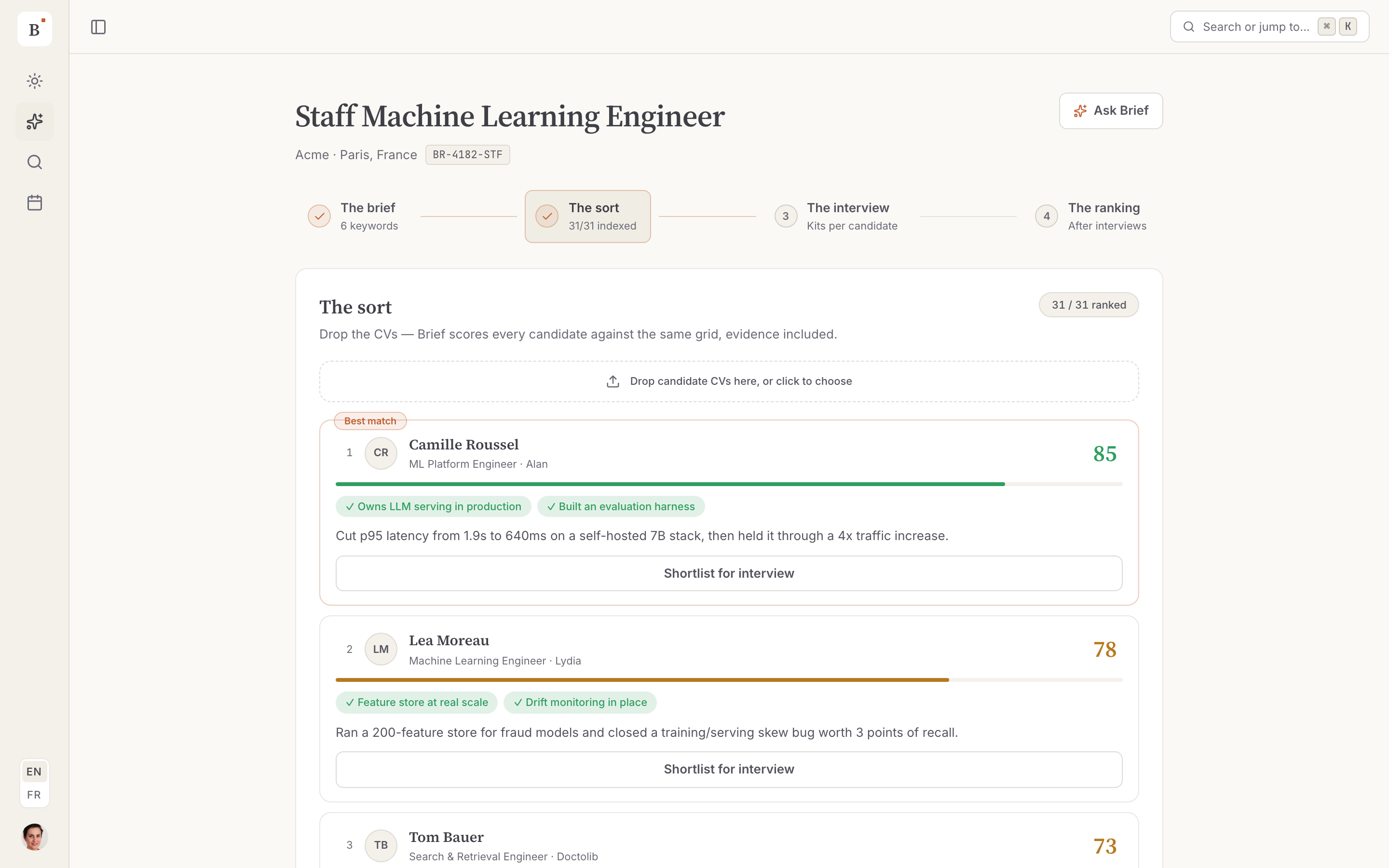
Drop the job posting. Brief extracts the criteria that actually decide the role and hands them back for you to correct. What you keep becomes the grid.
Nothing downstream is scored on anything else. If a criterion is not in the brief, it does not weigh on a candidate.
Step 02
The sort
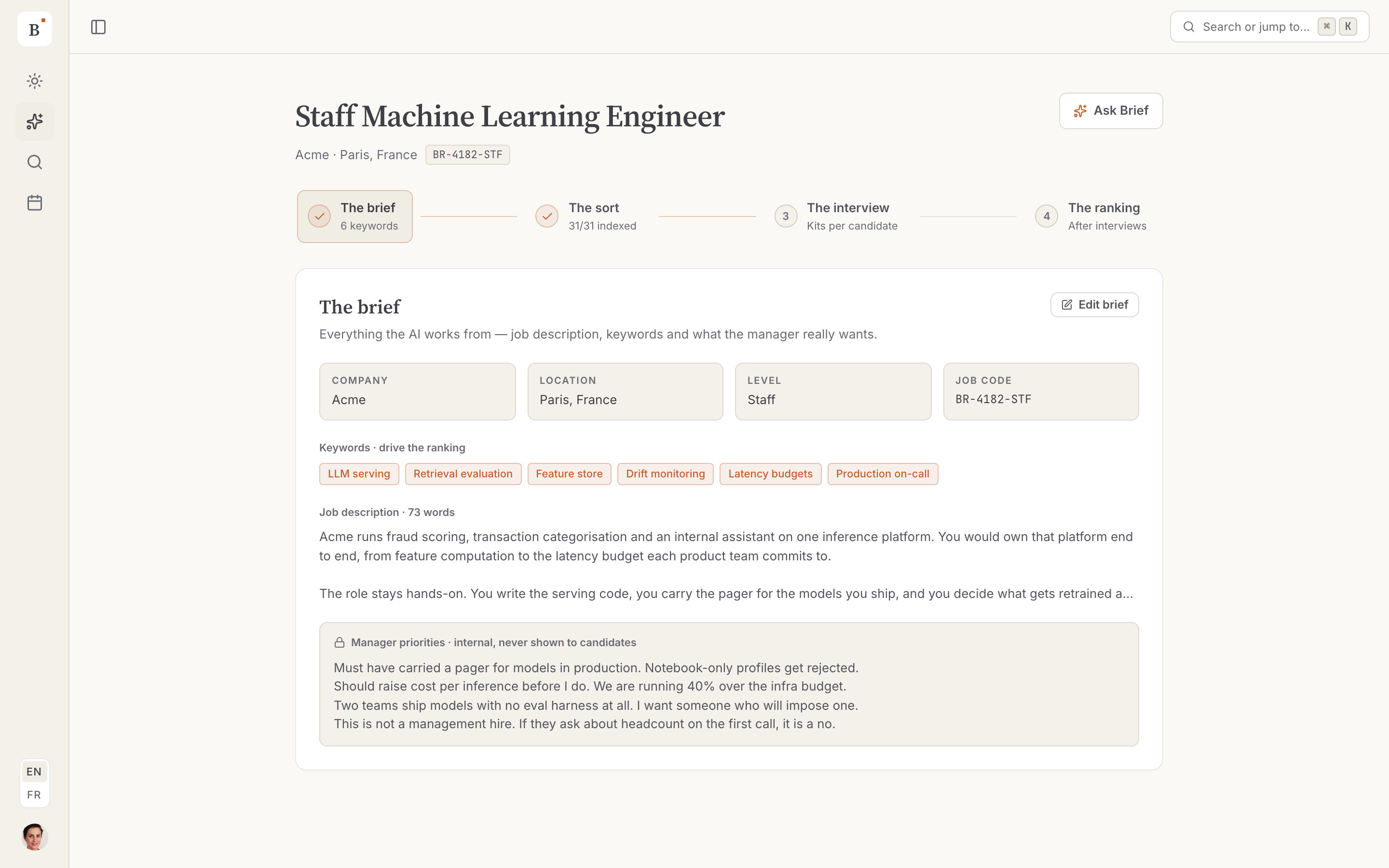
Drop the CVs. Every candidate is scored against the same grid, ranked, and given a one line reason with the matching passage quoted underneath.
This is where the hours go today, and it is the part a machine should carry. You still read the shortlist. You just stop reading the other forty.
Step 03
The interview
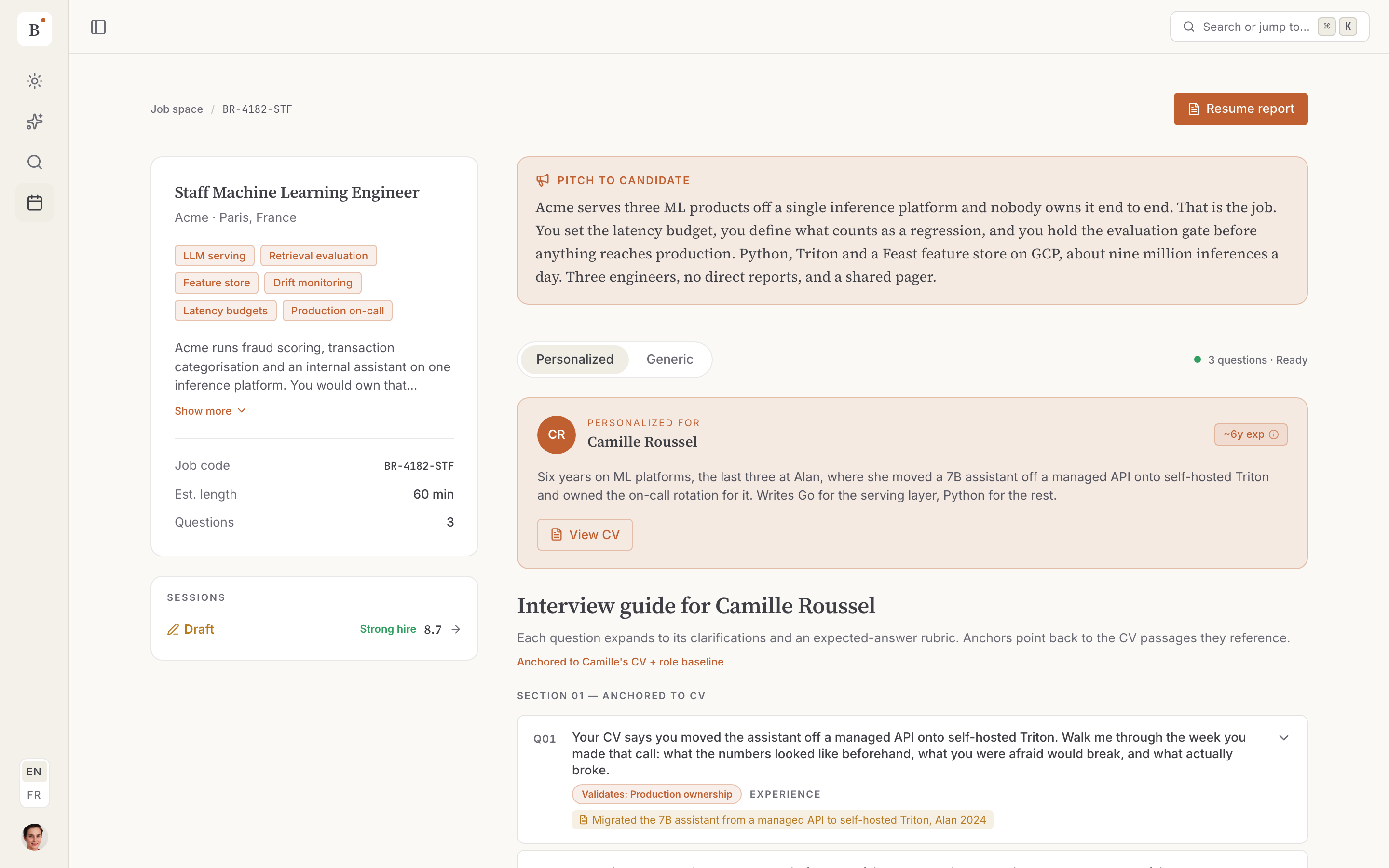
A guide is written per candidate before the call: questions anchored to their CV and to the role, each with what a good answer contains. Senior roles included, in domains you do not practise yourself.
During the call, Brief follows the transcript and suggests the follow up worth asking next, based on what the candidate just said. You ask it, or you do not.
Step 04
The ranking
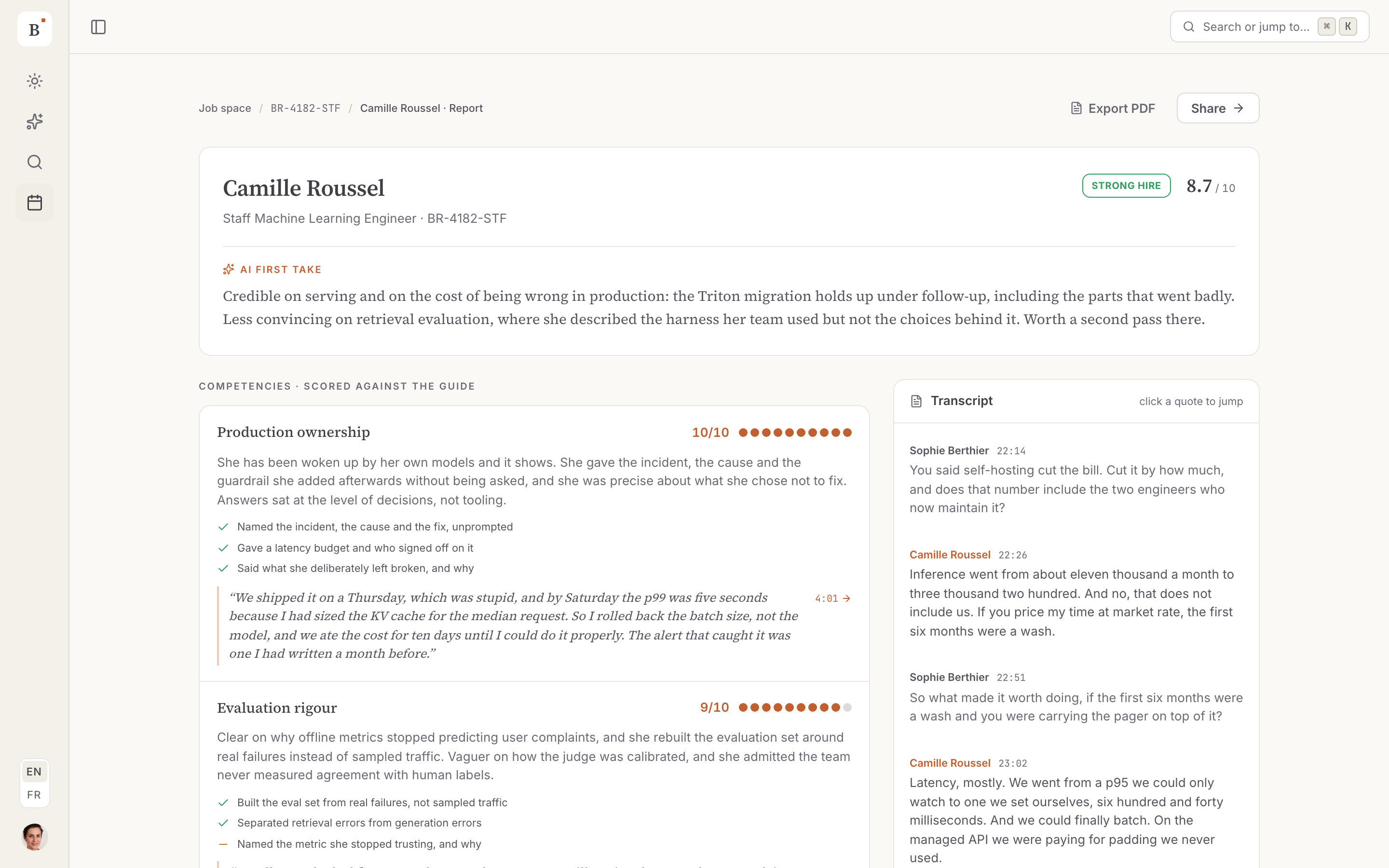
Upload the recording or paste the transcript. Each competency is scored against the guide, with the quote that justifies it and a timestamp back into the conversation.
The recommendation is a draft, pre filled and editable. Two candidates, six weeks apart, are finally graded on the same thing.
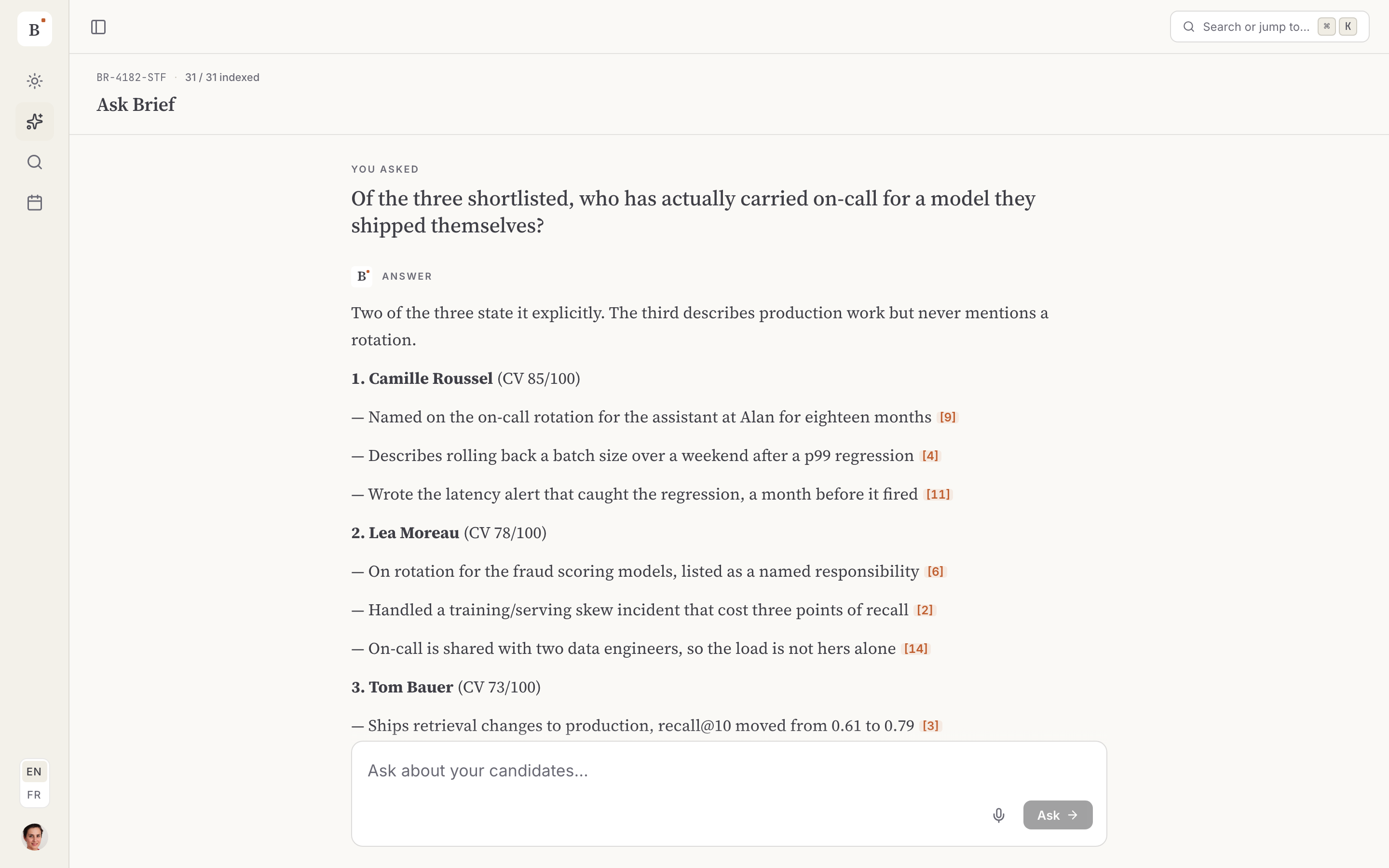
Ask Brief
Ask about your candidates. Get sources, not a guess.
Every answer is grounded in the CVs, guides and transcripts in the job space, with the references attached. When the sources do not say, Brief says that instead of inventing it.
Specialised where it matters
A general model was trained to be helpful about everything.
Hiring is not everything.
Brief is built for one job, and for the ways that job goes wrong.
Scores are anchored to the criteria in your brief and quote the passage they came from, so a number is never an opinion you cannot audit. The assistant is designed to keep the reasoning on the work: what the role requires, and what the candidate has evidence of. Not a gender. Not a disability. Not a name, an origin, or an age.
No tool removes bias from hiring, and any tool that claims to should worry you. What a tool can do is refuse to add its own, show its reasoning in full, and leave the decision with the person who is accountable for it.
Anchored to the brief
A candidate is measured against the criteria you approved for the role, and nothing that was never part of it.
Evidence you can open
Every score carries the passage or the verbatim behind it. If the evidence is thin, you see that it is thin.
Overridable by design
Rankings, questions and recommendations are drafts. You edit them, ignore them, or throw them out.
For head hunters
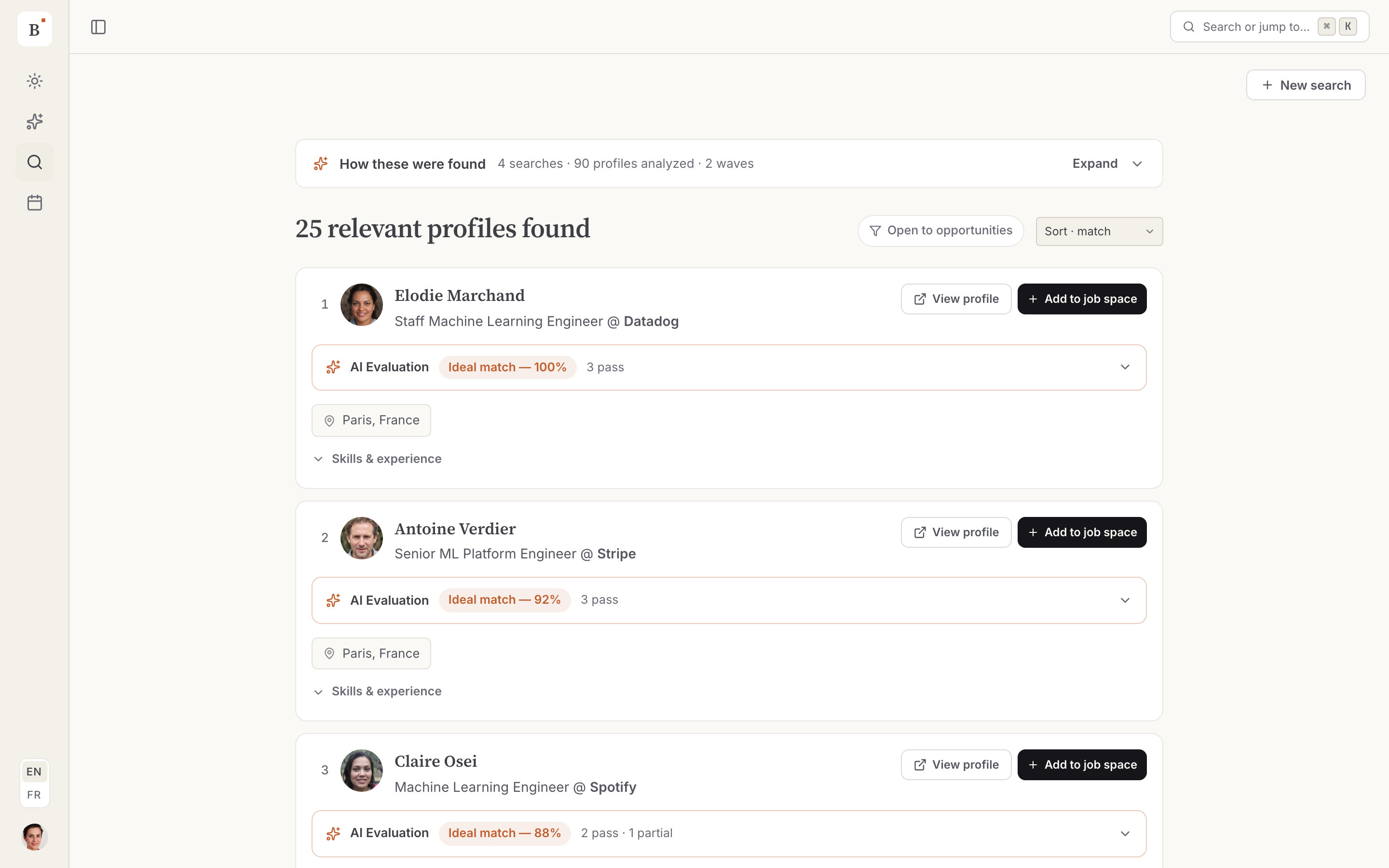
Describe the person you are looking for. In a sentence.
Search several profile banks in plain language, get the profiles back scored against your criteria, and move straight from one search mission to the next.
Building in public
The product is early, and we would rather say so
Brief is in beta. Here is what works today, what is being built this month, and what comes after. If your week needs something that is not on this list, that is the most useful thing you can tell us.
- Job spaces, one per role
- Bulk CV scoring against your brief
- Interview guides per candidate
- Transcript upload and recording
- Scored reports with verbatims
- Natural language profile search
- Ask Brief, with sources
- Live question suggestions during the call
- Shared report links for clients
- Candidate questionnaires before the interview
- Multi round tracking per candidate
- Beyond the CV: the web presence engine
- ATS export
- Your own scoring grids, saved and reused
- Team job spaces
Early access
Tell us what your week actually looks like
We are taking on a small number of independent recruiters for the beta. Brief is built week by week, in the open, and the point of the conversation is to find out where it helps and where it does not yet. Both answers are useful.